Skip to content Sign in Book a call

kinux GmbH, Thun

Business analysis, requirements engineering and AI development for insurers.

kinux GmbH supports projects in which business, sales and IT have to come together: from analysis through requirements to rollout.

Engagement as requirements engineer, business analyst, product owner or AI engineer, for one phase or across the whole project.

Services

Three fields in which kinux GmbH supports insurers. Business knowledge is written down so that IT can build on it and the business can check the result.

Requirements and analysis

When a project starts or stalls.

  • Capture and map current and future workflows
  • Business concepts and specifications that business and IT sign off together
  • User stories with acceptance criteria
  • Business rules as decision tables
  • Interfaces and data flows between core system, portals and partners
  • Vendor evaluation and business case

Product and delivery

When requirements need to become a product.

  • Product ownership with backlog and prioritisation
  • Clickable prototypes and screen designs, built with AI within a few days
  • Workshops with the units involved
  • Test cases and acceptance with the business
  • Rollout, training and handover to operations

AI projects

When AI is to be assessed or introduced without the team spending weeks on trials alongside daily business.

  • Scope the use case and quantify the benefit
  • Prototype with real documents, built by kinux GmbH, before a project starts
  • Requirements for data quality and the provenance of every answer
  • Review questions and tests the business can reproduce itself
  • Evidence in line with FINMA Guidance 08/2024: governance, inventory, data quality, testing, documentation, explainability, independent review
  • Support through to operations and ongoing monitoring

Why projects fail

Three of the five most frequent causes concern requirements, vision and communication.

Out of 16,000 projects, University of Oxford1
over budget, over time or both91.5 %
on budget and on time8.5 %
on budget, on time and with the promised benefits0.5 %
Most frequent causes of failed projects (selection), Project Management Institute2
Change in the organisation’s priorities39 %
Change in project objectives37 %
Inaccurate requirements gathering35 %
Inadequate vision or goal29 %
Poor communication29 %

Dark bars mark the causes that business analysis and requirements engineering address directly.

AI projects follow the same pattern. In 2025 BCG counts only 7 percent of insurers that have scaled AI beyond the pilot; around 70 percent of the obstacles lie with people, organisation and processes, not with the technology.3 FINMA found in 2025 that about half of 400 surveyed institutions use AI or are developing first applications; the main risks named are data quality, data protection and explainability.4 In core system renewals BCG observes that the accumulated complexity of legacy systems is carried onto new platforms, that large programmes follow the waterfall model and that too much responsibility sits with the vendor.5 This is where business analysis and requirements engineering come in: clarify objectives and requirements early, involve all parties from the start.

  1. Bent Flyvbjerg and Dan Gardner, University of Oxford: How Big Things Get Done, 2023, database of more than 16,000 projects from over 20 fields in 136 countries. 8.5 percent keep budget and schedule, 0.5 percent also deliver the promised benefits.
  2. Project Management Institute, Pulse of the Profession 2018, 4,455 respondents, primary causes of failed projects, up to three answers: report as PDF.
  3. Boston Consulting Group, 4 September 2025: Insurance Leads in AI Adoption. Now It’s Time to Scale.
  4. FINMA, press release of 24 April 2025, survey on the use of AI at around 400 institutions: FINMA survey on AI.
  5. Boston Consulting Group, 3 May 2024: Three Paths to Modernizing Core IT for Insurers.

Between business, sales and IT

The people who link these areas are usually at home in only one of them. That is where projects lose time.

Three areas, one shared centre Business and product, sales and customers, and IT form three separate sectors. kinux GmbH occupies their shared interface. Businessand product Products, processesand tariffs Sales andcustomers Advice, salesand daily practice IT Architecture, interfacesand data kinux GmbH

Business and product. Specialists know products and processes in detail, but often lack the view into the technology: what is feasible, and what will a decision cost later in operations?

Sales and customers. Specialists who understand the technology have rarely worked in advice or sales themselves. What is missing then is a sense of how advisors and customers experience a product or a tool day to day.

IT. Developers know interfaces and architecture, but rarely the rules behind a tariff or how a customer conversation unfolds.

Ugur Kinik, managing director of kinux GmbH, knows all three areas from practice: requirements and processes at banks and insurers since 2018, more than 15,000 customer conversations conducted personally, IT through developing and operating the kinux system, plus more than 1,000 hours of productive work with AI, kept current with the developments.

In 2024 BCG surveyed more than 1,000 senior executives in 59 countries: more than two thirds of large technology programmes miss schedule, budget or scope. 57 percent cite the lack of shared leadership between business and technology. According to BCG, teams lack specialists who can define, validate and prioritise requirements.

Boston Consulting Group, 13 November 2024: Most Large-Scale Tech Programs Fail. How to Succeed.

Proven on its own system

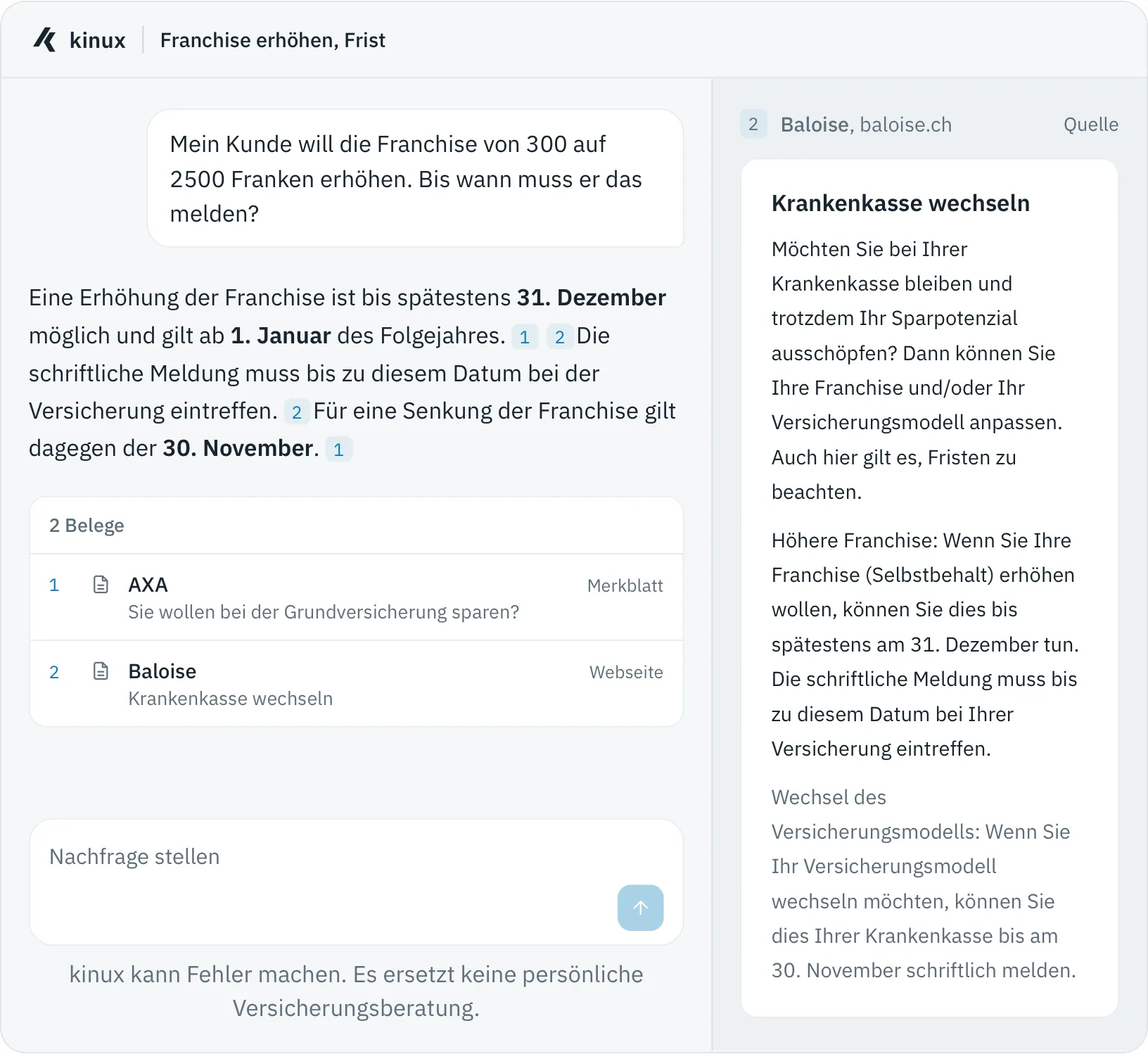
kinux GmbH develops and operates the kinux system for advisory teams at insurers. It answers insurance questions from more than 100,000 documents of Swiss insurers and cites the source for answers drawn from these documents; one click opens the passage in the original. Application and database are hosted in Switzerland, the language models in the EU data zone.

The system was built with the same approach as a client engagement: requirements and review questions first, then development. More on the product page.

kinux product view: question about the deductible, answer with two sources
Answer in the kinux system to a question about changing the deductible, with two sources and the original document alongside. German interface.

Your contact

Portrait of Ugur Kinik

Ugur Kinik

Managing Director, kinux GmbH

Ugur Kinik has worked in advice, sales and requirements management since 2018, at a major bank and at insurers. Most recently he was requirements engineer and business analyst at a multi-line insurer. BSc in Business Administration, certified insurance intermediary (VBV), IREB CPRE Foundation Level, ISTQB CTFL, PSPO I, PSM I.

Contact

A 30-minute conversation about the project, followed by a written assessment. ugur.kinik@kinux.ch

Request a conversation